the national disaster services web site at
and click on the Training Section.
From there we expand
our services to provide
personal items, shelter,
case management and
assistance with short-
and long-term recovery
plans. Typically there are
more disaster relief needs
than any one agency can
handle, so we work closely
with partner organizations
and local, state and federal
government agencies.
enrolled in training
programs that cover
everything from Disaster
to Emotional and Spiritual
Care. Training sessions take
place regularly throughout
the territory. We maintain
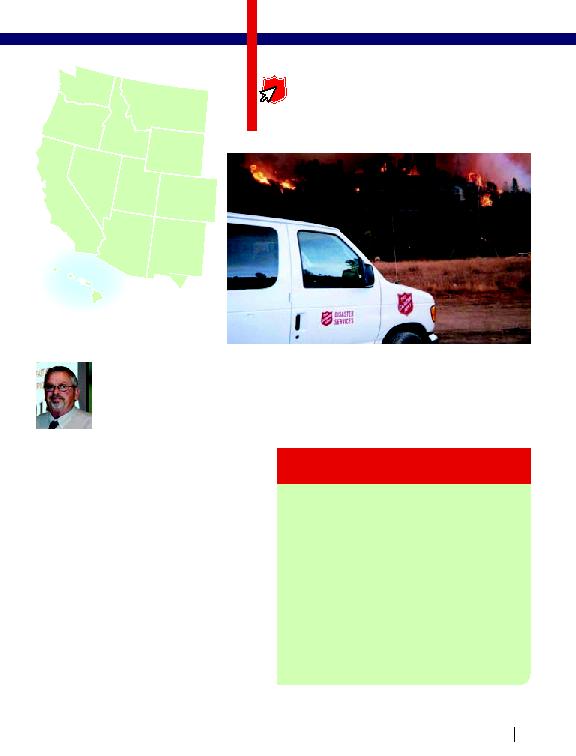
a fleet of disaster response
vehicles consisting of
everything from full
service mobile kitchens,
support vehicles and
communication vehicles.
Several warehouses are
pre-stocked with disaster
response supplies. All
Army facilities, including
camps, are available for
use in support of major
disasters. Personnel
and trucks at Adult
Rehabilitation Centers are
also available to respond,
making for one of the
largest fleets of transport
vehicles in the west.
communications unit
that consists of satellite,
cell phones and Internet
access. SATERN steps
up when all other forms
of communications fail
divisions communicate
with each other and
territorial headquarters.
management customized
to each person or family
coordination with other
agencies. The Army is
one of only a handful
of agencies to remain
engaged with affected
communities throughout
the entire disaster event.
each sized and typed
in accordance with
federal guidelines
mobile units able to
cook and provide 750
to 3000 meals twice a
day without
resupplying
for satellite and ham
radio communications,
Internet connectivity
and hot spot service for
first responders.
warehouse space
of more than 5,000