10
The War Cry | AUGUST 2015
The only disaster site for Katrina
would have been the Mississippi
Gulf Coast, and that was bad
enough!" When the surging waters
breached the levees cradling the
Crescent City, which sits below
sea level, 80 percent of New Or-
leans was plunged underwater. It
was a nightmare of two natural di-
sasters in one: a Category 5 hurri-
cane and a flood. "If Katrina had
not wobbled southeast of New Or-
leans, taking it due north into Gulf-
port and Biloxi [Mississippi], New
Orleans would have been totally
destroyed," Worthy theorizes.
In the 10 years following Ka-
trina, The Salvation Army has
played a monumental role. The
Army assisted individuals and fami-
lies with immediate needs and re-
built thousands of homes during the
long-term recovery phase. Beyond
everyone's control, however, are the
unsightly areas where only some of
the damaged homes have been ren-
ovated or rebuilt. This is particu-
larly true of the neighborhood hit
hardest, the Lower Ninth Ward,
where one can see a beautiful home
on one reclaimed lot and an aban-
doned, dilapidated one next door.
Chela Clark is a caseworker at
area command in New Orleans.
Hurricane Katrina wreaked water
and wind damage on her house, but
living on the West Bank in Gretna
saved her home from the destruc-
tion seen on national media. Chela
is still amazed that the Army pro-
cessed roughly 600 clients a day in
the following months--providing
transportation and distributing
vouchers for immediate needs, su-
permarket gift cards, furniture and
clothing. "One case among the
thousands was one homeless vet-
eran who lost his home even before
Katrina," she recalls. "We housed
him in our shelter for some time
until we were able to find perma-
nent housing. For a long time after
he got his new home, he came by at
least once a week to visit...If there
is one good thing that can come out
of a disaster like this, it's that a lot
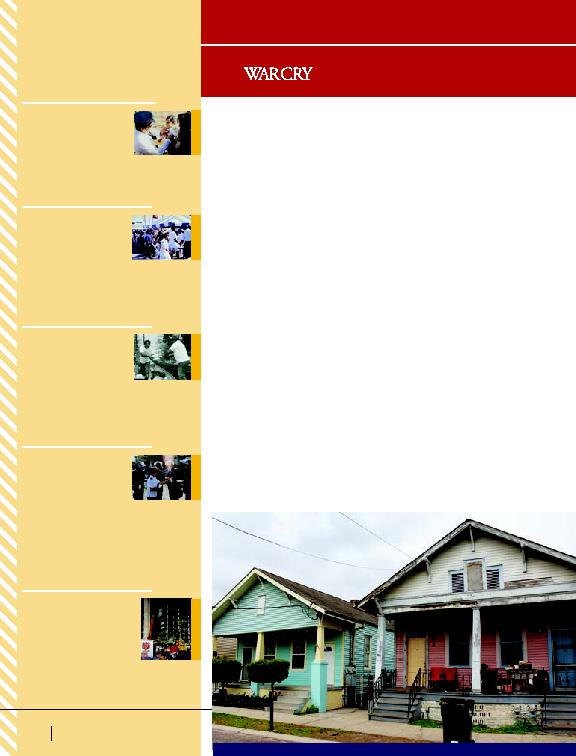
A common sight throughout New Orleans: one house
renovated and the adjacent lot untouched for a decade.
Snapshot:
25 Years of the Salvation Army
Emergency Disaster Services
in the United States
1991
COSTA RICA � The Army pro-
vided shelter, food, water, clothing
and more to some of the 80,000
people made homeless by the
severe earthquake April 25.
OAKLAND, CA � Army canteens
provided the first on-site relief to disaster workers when
wildfires killed 24 and cause over $5 billion in damages.
CHILE � Mud slides claimed 125 lives. Over
4,000 homes were destroyed and 35,000 people
left homeless. The Army provided $10,000 in aid.
1992
MERIDIAN, MS � Tornados
damaged or destroyed over
200 homes, killed three people
and injured 58. The Army
was on the scene right after the
twister went through the area.
FLORIDA & LOUISIANA � The Army distributed 27
million lbs. of supplies from seven distribution centers
to 20,000 people daily in the Homestead area alone.
KAUAI, HI � Within 36 hours of Hurricane Iniki,
the Army was providing hundreds of meals every
hour to residents, relief workers, volunteers, police
and firefighters and sheltering the 1,000 left homeless.
1993
TIJUANA, MEXICO � More than
10,000 people left homeless by tor-
rential rains in this city across the
U.S. border received food, clothing
and shelter from emergency crews
including personnel and supplies
from Southern California.
MINNESOTA to MISSOURI �
The flood of '93 saw the Mississippi River cover 16,000
square miles, including 20 million acres of farmland.
In Operation Noah's Ark, Salvation Army volunteers
delivered hot meals by boat to stranded residents,
while canteens were dispatched, shelters established
and supplies distributed in key parts of the region.
1994
SOUTHERN CALIFORNIA �
"Operation We Care" provided
critical assistance to thousands
of victims, police, firefighters,
relief workers and the National
Guard after a 6.6 earthquake
reduced thousands of residences to tomb-like shells.
SOUTHEAST � Army opened 50 relief centers for flood
victims in Alabama, Florida and Georgia.
RWANDA
� 600 tons of clothing was distributed to refugees of
ethnic conflict. Over 350,000 Tutsi tribe members were
housed in shelters made of plastic sheeting or canvas.
PITTSBURGH, PA � After the crash of USAir 427, two
canteens, a mobile command post and two large EDS
trailers assisted workers and families of victims at the
morgue, the crash site and the command area.
1995
OKLAHOMA CITY, OK � Minutes
after the April 19 bombing of the
Alfred P. Murrah Federal Building,
relief teams were on the scene of-
fering blankets, food, beverages and
other assistance to victims and res-
cue workers.
CALIFORNIA � Food,
shelter, and supplies provided for
thousands of flood victims, evacuees and rescue
workers in Northern and Southern California
during heavy rainstorms and resulting floods.
KATRINA +
SPECIAL
REPORT:
continued on pg 12
8-17, 24,25_Katrina_WCAug15_Werk7.indd 3
7/15/15 4:25 PM