Rob and Janine Vincent, Majors Tar-
ryl and Sharon Ray, Majors Alan
and Belinda Hill, and now, Majors
Gary and Beth Sturdivant. All of
these are dedicated officers to whom
much is owed by our community."
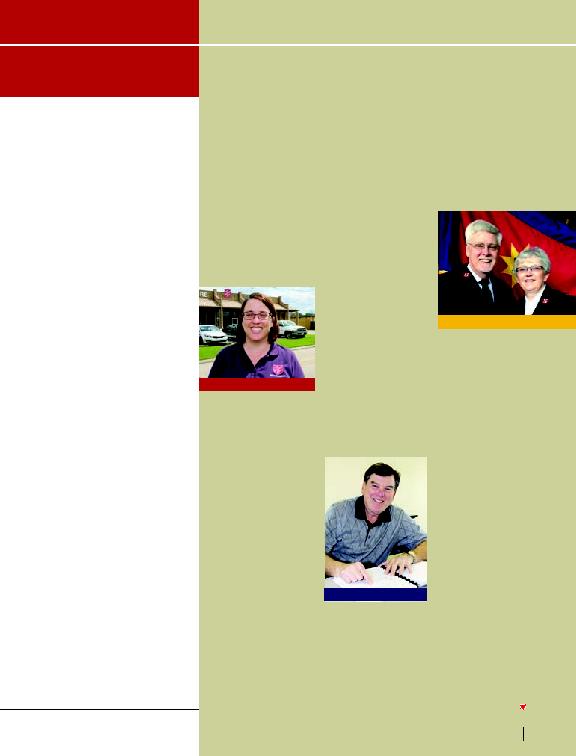
Angela Grandberry is a staff
member at the Kroc Center. She
came aboard when it opened in
2012. She barely remembers Hurri-
cane Camille, which struck the
area in 1969, but she is certain
Katrina was much worse by what
she's heard from her extended
family. "My husband stayed at our
house, and I took our children to
our church for shelter," Angela
says of Katrina. "When the ocean
started coming into our house, my
husband ended up in our attic
until the water went back down.
At our church, we had to move
up to the second floor, and we
were terrified."
"My children are resilient and ap-
pear to have no psychological dam-
age from the trauma," she says,
adding, "but I'll tell you one thing: if
another storm like that comes along,
I'm one of the first to evacuate!"
Major Gary Sturdivant, the
current Mississippi Gulf Coast
area commander, remembers,
"Before August 2005, residents
along the Gulf Coast referred to
Camille as the worst hurricane to
come through here. Now, they
speak of Katrina. I reckon they
will for a very long time."
Many are unaware of a third
area affected by Katrina. Majors
Mark and Mary Satterlee opened
the doors of the Army's administra-
tive office on Airline Highway in
Baton Rouge, Louisiana, to find
continued from pg 11
I had was to supply clean
towels and washcloths
for our volunteers and
workers for their showers.
A lot of times the towels
wouldn't make their way
back. One day we were
down to our last supply
and I prayed mightily to
God. Don't you know that
that very afternoon a lady
drove up and had me empty
out her back seat: boxes
full of clean, folded towels!
Man, that was beautiful!"
Christy Marshall is the
daughter of Carl and Ethel
Phillips; all three are faith-
ful soldiers of the Baton
Rouge Corps. Christy is
also the corps' Christian
education director.
"It was awesome to see
how people were helping
one another. Even some
aff ected by the disaster
were eager to help total
strangers. I was so proud
to see the Army allowed to
wade into places where
the general public could
not to take food and water
to people who were trying
to put their lives together.
We tried to meet their
physical and spiritual
needs. Some young people
still come to the corps as
a result of our disaster
relief. One of those kids,
someone we all called K.K.,
came to our corps for a
long time. It wasn't until
much later that [I learned]
K.K. stood for Katrina Kid!
She loved it!"
Gerald Garrison is the
current chairman for the
Salvation Army's advisory
board, and has been a
member for 20 years. His
participation in the relief
eff orts in Baton Rouge
was critical to the success
of the massive response.
"When you take a city
with a population of
400,000 and add another
400,000 to it, you have a
disaster in its own right.
There was no food, no gas,
no power. The city infra-
structure couldn't handle
it. People were literally
dumped [in Baton Rouge]
with nowhere to go, no
transportation and no
means of support.
"I did a lot of work with
the radio stations. The
clear-channel radio group
expanded our appeal to
their entire network [but]
they gave my personal cell
phone number. I'd get a
call, like, `I'm Joe Smith,
and I'm driving from Okla-
homa with a truckload of
water. Where do you want
it?' Fortunately, we se-
cured a warehouse, and
what we didn't take to the
Army's distribution center
we took to the warehouse
until we needed to restock.
It was all hands on deck!"
Maj. Mark Satterlee was
the corps offi
cer in Baton
Rouge from 2004 to
2006.
"Immediately after the
levies had given way, the
population of Baton Rouge
doubled overnight. The
city already suff ered from
a housing shortage, and
the sudden infl ux from
New Orleans threatened to
overwhelm city and social
agency services. We had to
put most of the volunteers
up at the Army's corps
building because no hotel
rooms could be found any-
where. We had people
sleeping everywhere.
"The amount of good
that The Salvation Army
was able to do was stag-
gering. Volunteers worked
24/7 to try and meet the
needs. I was amazed at the
dedication of the volun-
teers who were willing to
do anything to help."
13
The War Cry | AUGUST 2015
Disaster Response
Tailored to Meet
Varying Need
A +1O
Voices From Hurricane Katrina Relief in Baton Rouge
8-17, 24,25_Katrina_WCAug15_Werk7.indd 6
7/15/15 4:28 PM