11
The War Cry | AUGUST 2015
of people in New Orleans know
that they can depend on The Salva-
tion Army," she says.
There are many stories from
Katrina of heroics performed by
Salvation Army officers, employees
and volunteers, such as that of
Majors Richard and Fay Brittle,
New Orleans area commanders
at the time.
As floodwaters rose to nearly the
second floor of the four-story Cen-
ter of Hope--a complex offering
shelter and transitional housing
for individuals and families--the
Brittles and residents were
confined to the top floor, praying
for help to arrive. With no power
and no ability to communicate with
the outside world, Major Richard
was forced to begin rationing the re-
maining food. Marooned for days, he
and his wife refused to eat, and
when help finally arrived he re-
quired an IV and was evacuated by
stretcher onto a National Guard
helicopter.
Within a few months, Major
Richard contracted terminal can-
cer, likely caused by the toxic wa-
ters that flooded the building. He
was promoted to Glory in 2006.
Majors Richard and Fay Brittle are
credited with saving nearly 300
lives during that ordeal.
The scene on the Mississippi
Gulf Coast was also catastrophic,
but that area recovered more
quickly. Along Beach Boulevard
(US Highway 90), prime waterfront
real estate lies barren and un-
claimed to this day. Some stately
homes have been rebuilt; but what
remains is mostly lush, green grass
and the occasional bare foundation
Voices From Hurricane
Katrina Relief in Baton Rouge
A
lthough Hurricane Katrina wreaked near annihilation in New
Orleans and the Mississippi Gulf Coast, a very real drama also
played out in Baton Rouge, Louisiana. Many of the tens of
thousands of evacuees heading north and west stopped in Louisiana's
capital city--and at the Salvation Army's doorstep. Here are six fi rsthand
recollections of those nightmarish weeks in 2005.
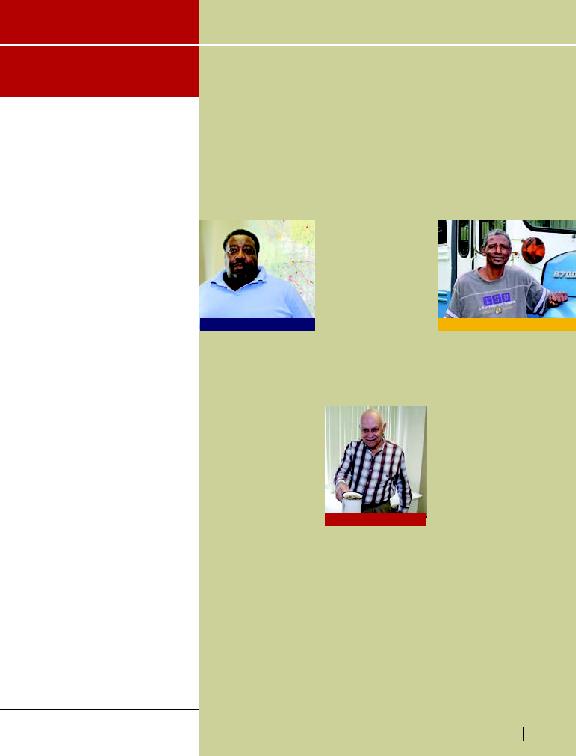
Arnold McDuffi
e has
called Baton Rouge home
for 25 years. He serves as
a business administrator
for the Army there.
"The day after Katrina
blew through, I took the
Army van out to survey
how bad things were. In
Port Allen I found several
hundred angry people
from New Orleans who
had made it that far and
ran out of money, food
and gas. They were so
angry, and I understood
that. I promised we would
do all we could. One of
the fi rst canteens we had
on site we sent there to
feed those people, and
we were there for several
weeks."
Dr. Gary Ter Haar has
been a member of the
Army's advisory board for
roughly 30 years. After
Katrina, he marshaled
fellow members of Broad-
moor Baptist Church to
assist the waves of evacu-
ees arriving in Baton
Rouge each day.
"Our church provided
scores of volunteers, and
we joined others who were
making sandwiches in the
[Army's] kitchen down-
stairs, thousands and thou-
sands of sandwiches...
People at our church had
the food trucked over here
to the Army for stocking
the canteens every day,
several times a day. We
also set up makeshift beds
at our church for out-of-
town volunteers. The Army
secured an old supermar-
ket and from there we dis-
pensed drinking water
and other supplies. There
were an incredible number
of refugees who needed
help, and an impressive
number of volunteers
who came to help."
Ronnie Phillips came to
the Army's Corps Salvage
Rehabilitation Center in
December of 2002 as a
recovering addict. After
graduating from the pro-
gram, he became an em-
ployee and eventually the
program director.
"What a blessing it was
to see the community
coming together. Every
morning I made my rounds
to all of the McDonald's
and collected 300 biscuits
and sausage and jelly from
each! I took them to our
distribution center in time
for breakfast. At the Distri-
bution Center there was
always a line of people
snaking way down the
street. We had pallets over
six feet high of water for
them, and thanks to Ready
Ice we had fi ve tons of
ice to give away.
"Another daily chore
continued on pg 13
Disaster Response
Tailored to Meet
Varying Need
A +1O
8-17, 24,25_Katrina_WCAug15_Werk7.indd 4
7/15/15 4:26 PM