corps. Marie was very familiar
with the Army's EDS ministry,
even before Katrina. "We lived in
an apartment complex on the sec-
ond floor, and we decided to ride
out the storm. The water came up
nearly to our balcony. I had a grill
and meat in the freezer that was
going to be bad since we had no
power, so I cooked everything and
fed as many people as we could!"
Post-Katrina soldiers at the Cit-
adel Corps have their own reasons
for becoming Salvationists. Joseph
Showers was in the New Orleans
ARC program that year, and evac-
uated with the other men to the
Houston ARC. He even graduated
from the program during their relo-
cation. "After I graduated, I went
to Baton Rouge to stay with my
brother, and we eventually both
went to work for FEMA back in
New Orleans," Joseph says. "Our
job was to help clean up the city. It
was a monumental task that I
thought would never end!"
Joseph says that when the Cita-
del Corps came back to life he
began attending worship services
and Bible study classes. He became
a soldier in 2008. Joseph has a
heart for ministry among homeless
men, and he still does whatever he
can to help feed and clothe the
homeless and bring them to church
services at the corps. "I'm so thank-
ful to God and to The Salvation
Army. My heart's desires are met
by being a Salvationist!" he says.
Valerie Murry is a Salvationist
of some 40 years. Today she feels
extremely blessed. She ended up in
Houston, and has been diagnosed
continued on pg 24
Saving Souls, Saving Lives
by THAD HICKS
H
ow does an organization like The Salvation Army, a group in-
volved in so many different works, balance the organization's
dual mandates of saving lives and saving souls?
Groups have long struggled with the
tension between preaching the gospel of
Jesus Christ and implementing develop-
ment or life-saving ministries (emergency
services, feeding, hospitals, etc.). Can The
Salvation Army do one without essen-
tially ignoring the other?
The Salvation Army was founded as
an Evangelistic Christian movement fo-
cused on sharing Jesus with the world.
While we do much more than that now, it
is still its foundation.
In an attempt to make sure we are
balancing the dual mandates of saving
lives and saving souls, Emergency Disas-
ter Services, one of the groups that make
up the Army's ministry, analyzed the Ar-
my's mission and found three main areas
on which relief services should focus.
1. Mission
We must verify that the work of the
Army always aligns with its mission "to
preach the gospel of Jesus Christ and to
meet human needs in His name without
discrimination." When we approach a task
we must run it through this fi lter.
2. Scripture
As a Christian organization, all we
do needs to be true to Scripture and bib-
lical teaching. While we are called to
serve mankind, we are to do so in Christ's
name. The commands we receive through
the Scripture are paramount. It should be
clear to all that the reason we do our
work is because of Christ and His sacrifi ce
for all of us. If we are too shy to make
this apparent, we cannot claim to be
scripturally focused.
3. Society
The Army often works with people
who have experienced life-altering
trauma. Research shows that when peo-
ple are at this low point they are more
susceptible to change and could be con-
vinced to convert to anything, but does
that make it right? Is this approach ben-
efi cial to society? What makes for a true
Christian conversion? Our approach
should always be measured by how it
promotes the welfare of society.
If we ask ourselves hard questions and
follow these three standards, we do not
have to choose between serving society
and spreading the Word. In fact, the two
concepts should not be separated at all,
but viewed as one, in order to be in line
with Christ's teachings. It is not saving
souls or saving lives, but saving souls
through
saving lives.
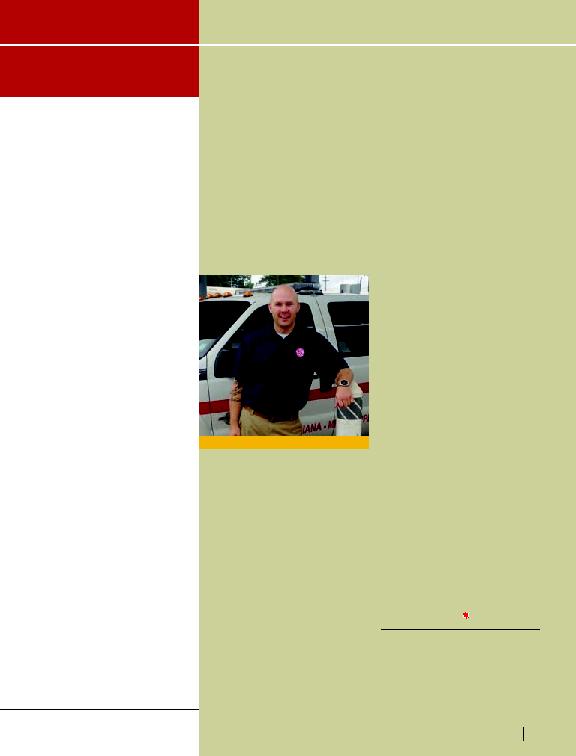
Thad Hicks is the Emergency Disaster
Services Director for the Army's
Alabama, Louisiana and Mississippi
Division. He is a certifi ed emergency
manager (CEM) and holds a PhD in
Intercultural Studies, with a focus on
organizational culture and its effect
on Christian missions.
y
Disaster Response
Tailored to Meet
Varying Need
A +1O
Thad Hicks
17
The War Cry | AUGUST 2015
8-17, 24,25_Katrina_WCAug15_Werk7.indd 10
7/15/15 4:30 PM