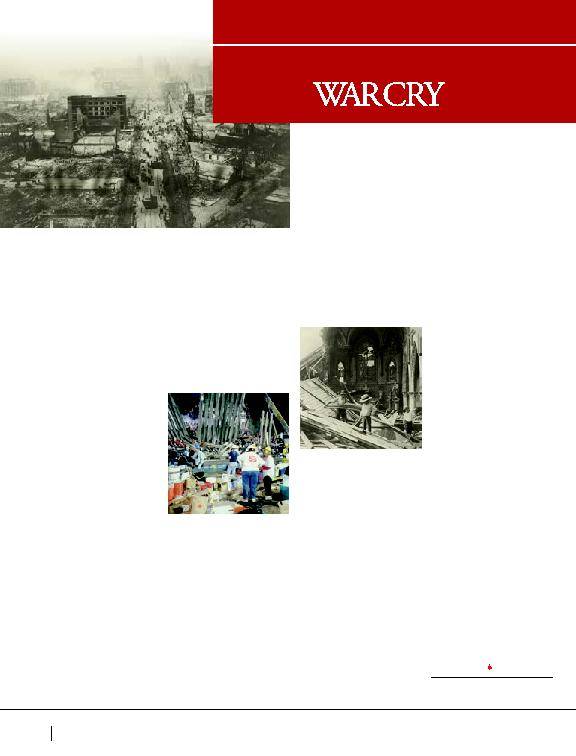
In 1900,
a devastating hurricane
struck the city of
Galveston, Texas.
Six years later, an earthquake rocked San Francisco.
The magnitude of these two disasters propelled The
Salvation Army into disaster relief, and in the years
since members of the Army's Emergency Disaster
Services (EDS) have gotten to know Andrew, Camille,
Katrina, Sandy and their destructive hurricane siblings.
They've served on-site after plane crashes, waited
for swollen rivers to recede and ministered in the
shadow of the fallen World Trade Center on 9/11.
As methods of disaster re-
sponse have become more ad-
vanced and systematic, the
Army's message has remained
the same--one of light in dark-
ness and hope in the midst of
despair and devastation. As
novelist Anne Lamott says,
"Hope begins in the dark, the
stubborn hope that if you just
show up and do the right thing,
the dawn will come."
When Hurricane Lee struck
Oswego, New York, in 2011,
fl ooding most of the commu-
nity's homes, Salvation Army
relief came to towns along the
Susquehanna River. EDS per-
sonnel distributed cleanup kits
and served hot food, basic
steps to help those aff ected
begin to redeem their lives. In
the tiny town of Barton, New
York, where nearly everyone
suff ered fl ood damage, volun-
teers whose own homes were
still fi lled with mud distributed
supplies and vouchers from the
Army. They also made apple
pies. While the scent of baking
apples didn't totally mask the
stench, it was a reminder that
hope was alive and well.
When the Mississippi River
fl ooded much of St. Louis in
1993, EDS personnel showed up
in red t-shirts emblazoned with
the Salvation Army shield.
Teams accompanied residents
as they re-entered their water-
logged homes to assess the
damage. Two veteran respond-
ers, Captains Larry Shade and
Bill Brewer, stood by as home-
owners surveyed FEMA notices
nailed to their doors. The cap-
tains were able to say, "Don't
be overwhelmed. Today we'll
decide what needs to be done,
and tomorrow we'll show up
with a team and start to work."
EDS volunteers assist victims
in crafting new narratives--per-
sonal, social, economic and
spiritual--in the midst of ruin.
Following the 1906 San Fran-
cisco earthquake, National
Commander Evangeline Booth
did just that when she said,
"The natural hopefulness... of
the California disposition has
stood them in good stead; all
their troubles and privations
have not been able to keep
them under. San Franciscans
have spirits like corks and come
back with a bounce every time."
Salvation Army workers sup-
port victims at their most vul-
nerable to help them recover
and rebuild, and to face the ter-
ror of the darkness in the light
of day. It was in testimony to
that truth that a trio of Salva-
tion Army musicians sang, "He
giveth more grace as our bur-
dens grow greater" to relief
workers gathered outside the
New York City Medical Exam-
iner's Offi
ce (the morgue) in
September 2001. Blocks away
at ground zero, Major Mollie
Shotzberger washed the feet of
weary fi rst responders; her own
tears an acknowledgement of the
darkness, her touch a reminder
that the dawn would come.
In this issue, we examine
Salvation Army disaster relief
through the lens of Hurricane
Katrina on its 10-year anniver-
sary. The Army's work following
Katrina serves as a microcosm
of Salvation Army emergency
disaster services: fl exible,
adapted to the specifi c needs
of individuals and communities,
and scalable according to the
magnitude of the disaster.
Across the United States and
around the world, The Salvation
Army stands ready, salvaging
redemptive narratives from
the wreckage.
Major JoAnn Shade lives in
Ashland, Ohio.
"
We'll Show Up"
by MAJOR JOANN SHADE
8
The War Cry | AUGUST 2015
SPECIAL
REPORT:
Top, Aftermath of the 1906
Earthquake in San Francisco.
Above, St. Patrick's Church
in Galveston, 1900.
Left, The
Army on the scene of the fallen
World Trade Center, 2001.
Right, Rescue personnel
search for victims of Hurricane
Katrina, New Orleans, 2005.
8-17, 24,25_Katrina_WCAug15_Werk7.indd 1
7/15/15 4:24 PM